

About
Leishmaniasis
Leishmaniasis is a parasitic disease caused by Leishmania parasites, spread through the bite of infected phlebotomine sand flies. It is classified by the World Health Organization (WHO) as a Neglected Tropical Disease (NTD), affects an estimated 12 million people across 98 endemic countries, and puts roughly 350 million more at risk.

Cutaneous
The most common form. Causes skin sores on exposed areas of the body that can leave lifelong scars and serious disability.
Mucosal
Affects the nasal, oral, and pharyngeal mucosa. Can cause partial or complete destruction of the mucous membranes.
Visceral
Affects internal organs — usually the spleen, liver, and bone marrow — and is fatal in over 95% of cases if left untreated.
What is Leishmaniasis?
Leishmaniasis is an important human and veterinary disease caused by Leishmania parasites that affect 12 million people in over 98 endemic countries. It is a parasitic disease found in parts of the tropics, subtropics, and southern Europe, and is classified as a Neglected Tropical Disease (NTD). The disease is now emerging in Europe due to climate change and massive population displacement. The parasite is known to rapidly adapt to novel environments with important consequences for disease outcome, and it has therefore been recognized as an emerging public health threat for the EU.
Leishmaniasis is caused by infection with Leishmania parasites, which are spread by the bite of phlebotomine sand flies. There are several different forms of leishmaniasis in people. The most common forms are:
- cutaneous leishmaniasis, which causes skin sores;
- mucosal leishmaniasis, which affects the nasal, oral, and pharyngeal mucosa;
- and visceral leishmaniasis, which affects several internal organs (usually spleen, liver, and bone marrow).
Leishmaniasis is among the five most important parasitic diseases worldwide, with an estimated 350 million people at risk of infection. The disease causes a spectrum of clinical manifestations ranging from disfiguring cutaneous to fatal visceral forms, which results from infection by different species of Leishmania parasites. These unicellular parasites adapt to a remarkable range of hosts. They grow as extracellular parasites inside phlebotomine sand flies that transmit Leishmania to a variety of vertebrates, such as rodents, dogs, and humans, where they grow inside immune cells, notably macrophages, causing severe pathologies that may lead to death.
Leishmaniasis is one of the most neglected diseases and as a consequence attracts limited attention. There is no human vaccine and only a few treatments are available.
How do people get infected with Leishmania parasites?
The main way is through the bite of infected female phlebotomine sand flies. Sand flies become infected by sucking blood from an infected animal or person. People might not realize that sand flies are present because:
- They do not make any noise;
- They are small: they are only about one third the size of typical mosquitoes or even smaller;
- Their bites might not be noticed (the bites can be painless or painful).
Sand flies usually are most active in twilight, evening, and night-time hours (from dusk to dawn). Although sand flies are less active during the hottest time of the day, they may bite if they are disturbed (for example, if a person brushes up against the trunk of a tree or other site where sand flies are resting).
Some types (species) of Leishmania parasites also may be spread via contaminated needles (needle sharing) or blood transfusions. Congenital transmission (spread from a pregnant woman to her baby) has been reported.
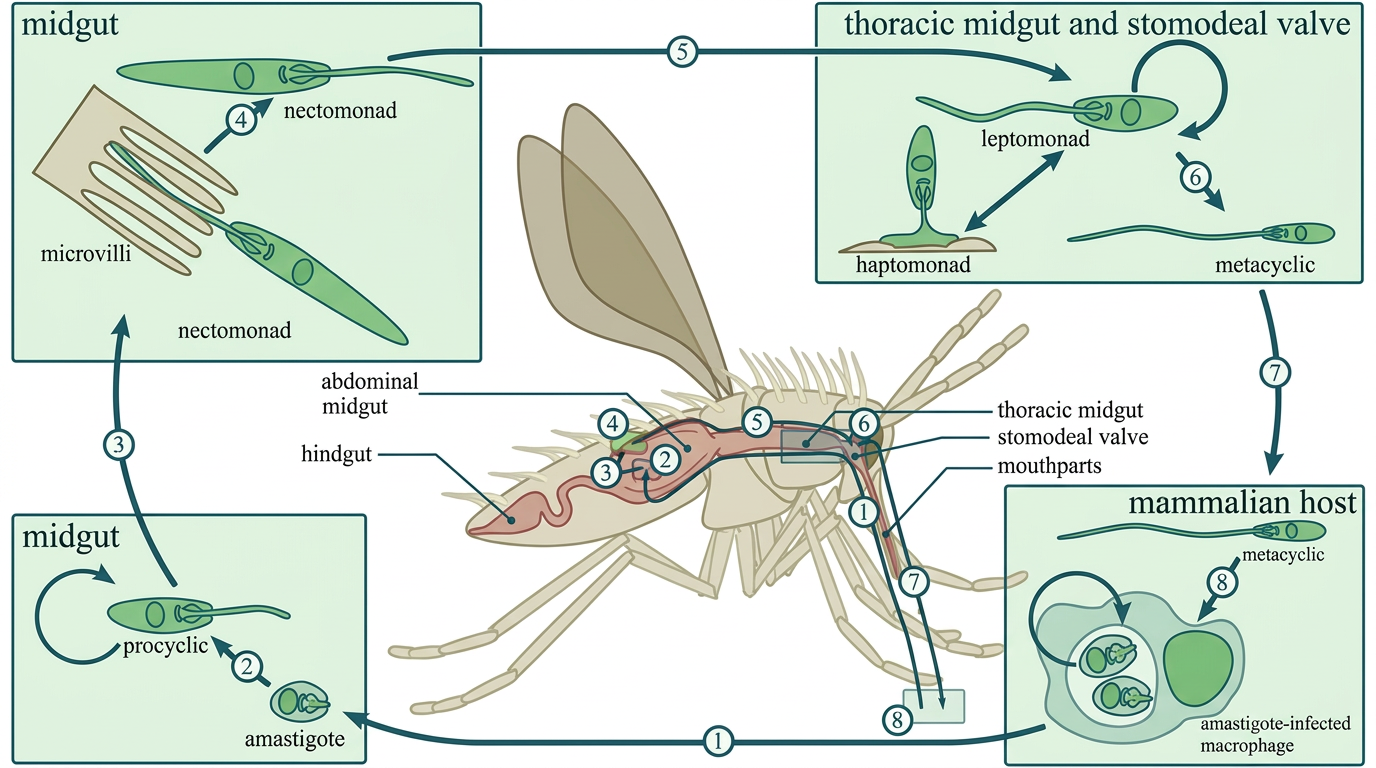
Lifecycle in the sand fly
The sand fly feeds on blood from an infected mammal and takes the amastigote form of the parasite into the abdominal midgut (1). There the parasite transforms to the procyclic promastigote form (2), attaches to the midgut wall (3, 4), and migrates back toward the mouthparts (5). Just before reaching the mouthparts it converts to its mammalian-infectious metacyclic promastigote form (6), ready to be regurgitated into the bite at the next blood meal (7, 8).
What is IMPAVIDO
(miltefosine)?
IMPAVIDO is a prescription medicine taken by mouth to treat certain types of leishmaniasis in adults and adolescents who are at least 12 years of age and weigh at least 30 kg (66 lbs).
- Taken by mouthAvailable as a capsule.
- A prescription treatmentApproved to treat certain forms of leishmaniasis caused by Leishmania species.
- For adults and adolescentsApproved for patients 12 years of age and older who weigh at least 30 kg (66 lbs).
One oral treatment
Three forms of leishmaniasis
- CutaneousSkin
- MucosalNose, mouth, and throat
- VisceralInternal organs